
The Hidden Cost of Being Likable
We are taught from a very young age that being nice is the ultimate virtue. We learn to smile when we are frustrated, to say yes when we want to say no, and to smooth over conflicts before they even start. We spend our lives trying to be the person everyone likes, thinking that this is the path to a happy and successful life.
But there is a heavy price to pay for being the person who never makes waves. The more you focus on being likable, the more you lose the parts of yourself that make you who you are.
For years, I was the ultimate people pleaser. I was the friend who always agreed with the plan, the employee who never pushed back on a deadline, and the partner who suppressed every grievance to keep the peace. On the surface, I was popular. People called me easygoing and kind. But internally, I felt like a hollow shell. I was so busy managing everyone else’s perception of me that I had no idea what I actually felt or wanted.
This is the central trap of people pleasing. You aren’t actually building connections; you are building a mask.
When you always agree, people aren’t falling in love with you. They are falling in love with the reflection…
True intimacy requires the risk of being disliked. To be truly known, you have to be willing to stand for something. You have to be willing to say, This is where I stand, and this is what I believe, even if it makes someone else uncomfortable.
The irony is that when you stop trying to be liked by everyone, your relationships actually get better.
When you start setting boundaries, some people will leave. That is the scary part. There are people in your life who are only there because you are convenient for them. When you stop being convenient, they lose interest. But the people who stay are the ones who actually matter. They are the ones who want to know the real you, not the…
https://youtu.be/hUP_0kV2qKo
Are you a people pleaser?
I sure was!
Growing up, I majored in pleasing others. I honestly believed as a child and young adult that if people didn’t need me, they wouldn’t want me. So I worked at being indispensable. My pleaser habit was so deeply rooted that I didn’t know I was giving up myself on a regular basis, in every relationship at home and work. And whoa!—the havoc it wrecked in my marriage!
People Pleasing Is a Mask
Pleasing others and keeping others happy was my full-time mask.
Why?
To be liked. To avoid conflict. To keep that proverbial boat from rocking.
All my relationships were one-sided: me the giver of time and favors and others happy to receive my generosity. It didn’t even occur to me to question this imbalance in my relationships; in my mind, that was simply the way the world worked.
I was continually overcommitted, overwhelmed, feeling rushed and exhausted because I never said no to anyone. And I was miserable.
Then one day, I noticed a recurring theme in my life: RESENTMENT
What most often followed my giving was feeling bitter and resentful. Hmm.
Did over-giving equal feeling resentful?
That concept intrigued me, so I started watching myself to see if this was a pattern. Was there a connection?
What I discovered changed my life.
The Hidden Message: “I’m Not Enough”
Each time I bent over backward to please someone else, it sent myself a silent—yet powerful—message: who I am, just as I am, isn’t quite good enough.
If I’m always tweaking myself to fit others’ expectations, I’m basically telling myself that nothing I had to offer the relationship was good enough. The idea that simply being accepted for who I am was lost in compliance and pleasing.
No matter how many thanks or smiles I collected in return, the payoff felt hollow. It was like I’d rewritten the rules for everyone else’s benefit.
And with every nod of agreement or forced yes, the unspoken message sank deeper: “Try harder. Do more. Maybe then you’ll be worthy of showing your true self.”
Overcoming Resentment Caused by Pleasing
After a month of self-introspection and tracking my resentful feelings there were two common themes.
My resentment led back back to only two things:
1) my giving was disproportionate in each relationship and always lacked a return current of reciprocity.
2) who I was and what I wanted was replaced by the needs and happiness of others—at the cost of my own thoughts, emotions, desires, dislikes, preferences, goals, and dreams.
I had handed the responsibility for all decisions over to others—even a decision as simple as where to go out for dinner. I neglected self-care until I got sick.
Boundaries? … What boundaries?
Looking back, I remember when my kids were young, stopping at McDonald’s when I didn’t even eat fast food! Or going to the grocery store and buying bags of groceries with nothing I liked; everyone else was happy though!
At work, I’d plow through lunch while my meal sat on my desk uneaten.
Related reading: “Do People Pleasers Make the Best Employees?”
Dependency and People-Pleasing
As my awareness grew, so did my dissatisfaction with my no-win behavior and habit of being a people pleaser.
The journey to being honest with myself and then with others was a gradual and often uncomfortable one. It hadn’t occurred to me how much of my life and actions were built around being kind to others for the sake of staying safe, looking generous, and avoiding conflict or rejection.
So, I did something bold: I removed the mask!
What was underneath was not pretty.
Most of my actions were tainted with an undercurrent of manipulation and subtle dishonesty. My words and actions were disrespectful and unloving to myself but also to others, since I wasn’t really giving from a free place.
I had surrounded myself with people who were dependent on me as a way to be liked and to create indebtedness—in exchange for a sense of safety and yes, love.
Gradually I realized that making anyone dependent on me was unloving, because it was enabling behavior that was not life-giving and tied the person to me in an unhealthy way.
Every dependent relationship is an alliance to protect ourselves from discomfort or past unresolved pain.
Pleasing was my cover-up.
When I even considered changing, many fears bubbled up—just like when you pour vinegar over baking soda.
People would say, “Just set boundaries!”
Yet, that concept seemed as strange as living on the moon. My sense of identity was enmeshed in being a people pleaser.
Possible Concerns for People Pleasers Wanting to Say No
Maybe you’ve experienced these fears, too; maybe your concerns are different.
Here are a few common ones that I’ve heard as an emotional fitness coach. Read each one in the first person to make it more powerful. See if any of these seem familiar:
- If I chose to say no when it didn’t work for me, would people get upset?
- If I voiced an opinion that disagreed with others, would I be disliked? rejected?
- If I said yes to me, would my life improve? Was it worth it!?
- When saying no to someone’s wish or request, would that relationship end?
- Would the person think I didn’t care if I didn’t give what they requested, needed or wanted?
- Who am I without being a pleaser?
Some of my relationships indeed did end.
And today, I hear that same fear frequently from my clients seeking to set healthy boundaries. It’s a natural concern. And change does disrupt old patterns in relationships.
But do you know what!?
In my life, as those old relationships dropped away, fresh space opened for new, healthier ones—real relationships. My energy and happiness increased, and an inner peace blossomed. Greater opportunities stepped forward. When I said no, I meant no. But when I gave my word, I really wanted to show up for my commitments.
And the people who really cared about me and loved me supported me through the transformation. Turns out, they really did want to know the REAL me!
Ways to Avoid Taking on Your Partner’s Emotions as a Pleaser
When attempting to separate yourself from your inner pleaser, emotions are often blurred in a relationship. It can be challenging distinguishing your feelings from those of your partner.
Here’s how you can maintain emotional clarity and support your partner without absorbing their emotions as your own or moving to please to avoid conflict.
Press Your Pause Button: Acknowledge and Reflect
When you’re aware of strong emotions surfacing during interactions with your partner, pause for a moment. Reflect on the source of the feelings.
Ask yourself whether they stem from your experience or you are in an echo chamber of your partner’s emotions.
People who gravitate easily toward pleasing and keeping others happy are often very empathic so the feelings of others can seem like your own. Increasing self-awareness will guide you to manage your emotional boundaries more effectively.
Communicate Openly
If you discern that the feelings you’re experiencing are more aligned with your partner’s experience, engage in a conversation. Instead of internalizing their feelings or jumping straight into fixing the issue, consider asking them what they need.
Frame your questions to understand whether they want advice, solutions, or simply someone who listens. Clear communication helps define your role in offering support without merging emotions. It also slows down the experience to respond more thoughtfully.
This small shift will help you to consider yourself in interactions and begin to know what’s right for you.
Practice Emotional Self-Care
Safeguarding your emotional well-being is important. Engage in activities that ground you and begin to separate you from your partner’s emotions.
This mindfulness practice might include deep breathing, journaling, meditation, or engaging in a solo hobby. These practices provide the space needed to maintain your emotional independence.
Take Baby Steps When Setting Boundaries
Establishing emotional boundaries is essential in any relationship. It’s okay to limit conversations when the emotional labor becomes overwhelming.
Compassionately express your need for space to process and regroup. Setting a boundary doesn’t mean pushing your partner away or shutting them out.
Instead, it ensures you’re equipped to support them without compromising your emotional health.
Reach Out for Support
Sometimes, the dynamics of a relationship when you have a habit of pleasing and the accompanying emotional absorption can be complex. You may need an objective person to help you walk through the personal changes.
An emotional intelligence coach can provide strategies tailored to your specific situation. They can offer tools to distinguish and manage emotional boundaries effectively while nurturing your relationship, improving both individual well-being and relationship health.
By using these approaches, you can be a supportive partner while safeguarding your own emotional well-being
The Benefits and Payoffs of Self-Love and Self-Reliance
I was flooded with an unfamiliar feeling—joy. My mind entertained new thoughts:
- What would it be like to have people in my life who were self-reliant, creative, fun, and open-minded?
- What if they really cared about me and even challenged me to be better?
- What would my life look like if I chose my truth and didn’t allow others to make decisions for me?
A brand new door opened.
Walk through your own door to freedom.
Action Encourages Confidence.
Regaining my self-acceptance went hand-in-hand with letting go of resentment.
The more I chose ME, the more inner peace I had.
And the more inner peace I gained, the more motivated I was to set healthy boundaries and choose what was right for me.
Self-Care Promotes Self-Love
All of a sudden, I had more energy and could take guilt-free naps when needed. I allowed time for self-care and prioritized time commitments so I had a better life-work balance.
The funny thing, I had more time for giving to the people who truly mattered to me and for fun activities, like cross-country skiing or spending time with my family in a get-away cabin. I was happier; there was no denying it!
Most people don’t realize that when we care for ourselves, we are loving ourselves.
It’s one of the reasons people-pleasers often feel so unloved. Not because others don’t love them, but because they continually throw themselves under the bus to please others, which isn’t loving!
When we take responsibility for loving yourself, others begin respecting us more. When we love ourselves, there is room for others to step into support and enhance that love.
How Do You Know If You’re a People Pleaser?
Psychology Today provides a fairly complete list of 15 Signs You’re a People Pleaser. You might look it over and see how many symptoms fit.
However, usually people pleasers KNOW who they are. They may not be able to articulate the exact signs, but they frequently identify themselves as pleasers.
If we define inordinate pleasing as compliance
without considering self, it is as though we are only
an extension of the will of another.
| By surrendering our personal values and the responsibility for our happiness, we are making others responsible for our welfare by default. So then, we often claim the right to blame someone else if things go badly. |
When we give up ourselves to someone else, true cooperation is impossible.
By surrendering our personal values and the responsibility for our own well-being and happiness, we are making others responsible for our welfare by default.
So then, we often claim the right to blame someone else if things go badly.
Even if we take some satisfaction in playing a martyr, ultimately we have a human need to be loved and valued, so this behavior backfires.
When people take us for granted, we feel uncared for, even if we initiated the inequality by giving without full consent. When we don’t consider ourselves, there is no room for equality in love and friendship.
The Price for Compliance: What Happens When We Give Ourselves Up?
- Our pleasing habit denies others the opportunity to help, give, and love us equitably.
- Our actions create indebtedness that has not been agreed upon, which holds others hostage to repay us for our sacrifice.
- Relationships are based on dishonesty (at the very least, not full disclosure), so there is no real connection.
- We give up our power, happiness, and freedom to contribute our best.
- Our unwillingness to be our own advocate or to speak our truth creates resentment and hidden agendas that often damage relationships.
Said another way: compliance is like a felony against self.
Why People-Pleasing Can Take a Toll on Your Health
When we put everyone else’s needs before our own, it’s easy to lose sight of self-care. People-pleasers often run themselves ragged, never truly stopping to rest, recharge, or tend to their own well-being.
Over time, this lack of self-care can catch up with us in ways that aren’t always so obvious at first.
Think of it like being the driver of a relief truck. If you never pause to refuel, eventually the truck sputters to a stop—no matter how noble your mission. Likewise, neglecting your own needs means you may miss out on sleep, skip meals, or let stress quietly pile up. The consequences can range from chronic fatigue to weakened immunity or even more serious health problems down the road.
It’s not selfish to care for yourself; it’s essential. Making room for your own well-being—by exercising, eating nourishing foods, or simply letting yourself rest—is how you keep your “tank” full. That way, you have the energy, health, and motivation to show up fully for others without burnout or running yourself ragged.
Real giving comes from a place of wholeness, not depletion. Authentic loving comes from a self-first place so we give from a free, overflowing place.
When you treat your own needs with respect, it isn’t only you who benefits—those you love will, too.
So, knowing the cost of pleasing, how do you break the habit of giving up yourself? A simple science lesson will help.
Related reading: “How Being Compliant and a People Pleaser Destroys Marriages”
A Brain Science Lesson: Why It’s So Difficult to Stop Pleasing
 The brain stem is our survival brain. Its first responsibility is our survival.
In the brain’s survival logic, our actions must be repeatable and survivable. Therefore it likes the familiar. It likes what it already knows.
Why? Because after centuries of refining what works and what doesn’t, the brain stem knows which actions are survivable.
Whatever we do over and over, the brain automates, because that’s very efficient—just like when you put your car on cruise control to stretch your legs.
We typically don’t exert any effort to change what already works (in my case, pleasing people in order to stay safe).
There are two things that motivate us: pain and pleasure.
So knowing the costs (what the brain doesn’t like) and a future goal with pleasure attached (such as greater personal fulfillment) will get the brain prepared for the change ahead. It also engages the rational and visionary brain, the frontal cortex, which is responsible for higher thinking, transformation, goal-setting, and envisioning.
All unconscious habits and beliefs are memorized by the body and become a state of being or part of our personality. It’s difficult to pull out a lifelong behavior from our lifestyle, because it has  become so familiar that we often believe that “it’s just the way we are.” It’s like pulling out a block without toppling the whole tower, like the popular game Jenga.
We’ve been taught that it’s better to give than to receive, but is it? If we only had givers, who would receive?
Receiving is essential. Our very first breaths were the first gift of life and breathing requires receiving.
Look at nature: even a tree must take (receive) from its environment before it can produce fruit. In our own lives, we cannot give until we have received. Nor can we give more than we have received. For example, if we do not have money, we cannot provide for our children or give to charities.
So to all those pleasers out there, give yourself permission to receive.
The Hidden Link: People-Pleasing, Stress, and Depression
So, what happens when our drive to please others quietly snowballs into something bigger?
Chronic stress and depression often lurk in the shadows of people-pleasing. When our days are spent rushing to meet everyone else’s demands, our own needs slip further down the list—and the pressure quietly mounts.
Stress isn’t just about feeling busy. It’s what happens when our giving goes unchecked; we end up with more on our plate than we can realistically manage. Trust me, I know and I get it. It feels great giving and pleasing others until it doesn’t.
Over time, this constant pressure strains us mentally, emotionally and physically. If left unaddressed, it can deepen into genuine exhaustion and even depression—especially when we begin to feel invisible in our own lives.
Here’s where change starts:
- Identify even one responsibility you can let go of, no matter how small. This small step is the first action in reclaiming a bit of balance.
- Rally support. Find a trusted friend, mentor, or counselor and share your commitment to carve out time for yourself.
- Remember, the goal isn’t perfection—just progress. Small acts of self-care make a big difference over time.
Breaking the cycle doesn’t mean abandoning kindness or compassion for others. When you honor your own well-being, you honor others. When you care for yourself with the same dedication you offer others, it’s a game changer!.
For support and skills to empower you: get our e-book, Advice from an Ex-People Pleaser: How to Stop Being a People Pleaser.
People Pleasers in Relationships: The Downside for Everyone with Too Much Pleasing
Let’s look at the downside of being too caring, compliant, and appeasing (the pain for the brain).
If a person cannot be honest about what they want in relationships or what they think in a conversation or what truly brings them joy, then it is impossible for them to be known or for anyone to know how to love them.
When their communications are only partial truths, incomplete or dishonest interactions degrade trust and connection.
There is nothing real or authentic in those relationships, is there?
When a person withholds who they are, everything that flows from that deception is also a deception.
In the area of contribution, if a person is not living up to their potential because their thoughts, desires, and actions are at the behest of others (or are chosen to avoid conflict with others), then society is denied their gifts, talents, and contributions that can be for the betterment of all.
Related reading: “Dating a People Pleaser? Top Ways to Foster Understanding and Good Communication,”
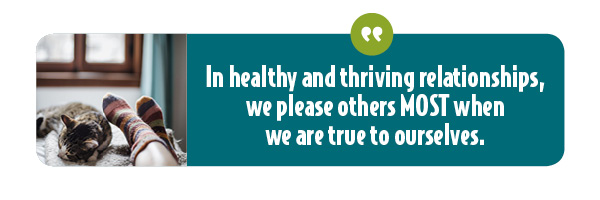
Think about that for a minute: We please others MOST when we are true to ourselves.
Why?
Because anything based on half-truths keeps us from having true connection, limits our ability to love others, and discredits everything we say.
Unspoken expectations and growing distance interferes with authentic communication. When I work with couples, this is often prevalent. People are frequently in the habit of telling their partner what is convenient at the time or omitting key details they think might upset their partner.
The Emotional Toll of People Pleasing
Another often overlooked downside is the emotional cost of chronic people-pleasing.
People-pleasers often suppress their emotions. We don’t take the time to process them, and sometimes we even believe we have no right to feel them. Common emotions like anger, fear, sadness, or even joy may be hidden if we worry they might displease others.
These unexpressed emotions don’t disappear—they build up inside. Over time, what we avoid feeling begins to leak out as sarcasm, criticism, or passive-aggressive behavior. Like steam building under pressure, these pent-up feelings can seep into every area of life, tangling up relationships and eventually erupting in outbursts or explosive conflict.
So if you’ve ever caught yourself snapping unexpectedly or wondering, “Why am I so emotional?” or feeling resentful when you’re “supposed” to be agreeable, you’re not alone. These are the natural byproducts of ignoring your own emotional needs for too long.
Authentic relationships require honesty, vulnerability, and the willingness to both give and receive—emotionally and otherwise.
When we deny ourselves the space to feel, express, and contribute as our true selves, everyone loses out: We lose touch with ourselves, and others lose the opportunity to know and love the real us.
Find out what to do instead!
⇒ If you’re ready to dig deeper and change, keep reading!
Is It Time to Stop Being a People Pleaser?
If you want to change how you interact with people and start making yourself a priority, the first step is awareness. So, start pausing before agreeing to anything is vital. Check in with yourself to see what’s right for you BEFORE committing to someone.
It’s great to know what we don’t want and what we do want, but where we get stuck is the how. HOW do we change?
To change successfully, we must know the obstacles in achieving our goal. So, let’s isolate the challenges you may run into, as well as give you solutions and practical actions that you can take.
People Pleasers in Relationships: Problems and Solutions
to Break the Habit of People Pleasing
PROBLEM #1:
You don’t know what you want.
More often than not, people pleasers aren’t clear on what they want because for far too long they’ve given in to please others or avoid conflict.
SOLUTION #1:
Figure out what you truly want.
You may need to start small. When your family is deciding where to go for dinner, ask yourself what you want for dinner. Your automatic response will be to go along with everyone else. Don’t. Take a few minutes to attune to your likes and your body’s needs and come up with an answer. If you’re not fond of sushi or Mexican food is too heavy for your liking, say so.
And practice! Ask yourself what you want dozens of times throughout the day. This practice will get you in touch with yourself, maybe for the first time ever. Once you’re clear on what you want, ask for it, preferably ahead of time before there is any stress or pressure.
PROBLEM #2:
Pleasers often neglect self-care.
When giving from a place of pleasing others more than taking care of ourselves, we give from an unsustainable place. Ignoring self-care robs us of our deepest desires—both minor and major.
When we give without considering ourselves, we often begin to feel a subtle murmur of resentment. Gradually, the volume will increase until we end up lashing out at a loved one. We’ve tolerated things for far too long. We’ve become so good at pushing those resentful feelings down and putting on that smile for others that we forget to check in with ourselves.
SOLUTION #2:
Begin a self-care program.
Why is self-care important? Let me ask you something. When you haven’t taken care of yourself, how do feel about yourself? (You’ve worked through lunch, neglected exercise, and missed your kid’s basketball game.) Are you tired? Unhappy? We cannot be at our best without taking responsibility for our well-being. Start today. A by-product of truly caring for ourselves is self-love, which increases confidence and self-esteem.
At times self-care involves an investment in ourselves like joining a yoga class or getting away for the weekend. Other times it’s simply having our favorite meal with loved ones. Maybe it means going for a hike in the woods or getting a manicure. And sometimes it’s as simple as taking a few deep breathes and looking at the scenery. Whatever renews you!
🌸 About Neeti Keswani
Neeti Keswani is the founder of Plush Ink and host of the Luxury Unplugged Podcast, where luxury meets spirituality. As an author, storyteller, and self-improvement coach, she helps conscious creators and professionals align with purpose, identity, and abundance through mindset transformation and emotional healing.
Her mission is to empower people to live with intention, authenticity, and joy — blending inner work with outer success.
Connect with Neeti:
🎙️ Luxury Unplugged Podcast — https://podcasts.apple.com/us/podcast/luxury-unplugged-podcast-where-luxury-meets-spirituality/id1551277118
📖 Instagram — https://www.instagram.com/luxuryunpluggedpodcast/
💼 LinkedIn — https://www.linkedin.com/in/neetikeswani/
🌐 Plush Ink — https://www.plush-ink.com/